Books

The Industry of Evangelism: Printing for the Reformation in Martin Luther’s Wittenberg
(Leiden: Brill, 2021)
Abstract:
Of the leading print centres in early modern Europe, Wittenberg was the only one that was not a major centre of trade, politics, or culture. This monograph examines the rise of the Wittenberg printing industry and analyses how it overtook the Empire’s leading print centres. It investigates the workshops of the four leading printers in Wittenberg during Luther’s lifetime: Nickel Schirlentz, Josef Klug, Hans Lufft, and Georg Rhau. Together, these printers conquered the German print world.
Reviews:
Sabrina Alcorn Baron, University of Maryland in Renaissance Quarterly, 77, no. 3 (2024), pp. 1012-1014. https://doi.org/10.1017/rqx.2024.62 (Open Source)
Johannes Frimmel, Ludwig-Maximilians-Universität München in Zeitschrift für Historische Forschung, 51, no. 2 (2024). https://doi.org/10.3790/zhf.2024.375151
Chris Cullnane II, Belhaven University in Libraries: Culture, History, and Society, 8, no. 1 (2024), pp. 79-81. https://doi.org/10.5325/libraries.8.1.0079
Andrea van Leerdam, Utrecht in Jahrbuch für Kommunikationsgeschichte, 25 (2023), pp. 191-92. https://dspace.library.uu.nl/handle/1874/433072 (Open Source)
Wojciech Kordyzon, Uniwersytet Warszawski in Odrodzenie i Reformacja w Polsce, 66, no. 1 (2022), pp. 205-212. https://oir-ihpan.edu.pl/en/tom-lxvi-2022
(Open Source: Polish, English)
Edited Volumes

Print Culture at the Crossroads: The Book in Central Europe
Edited by Elizabeth Dillenburg, Howard Louthan and Drew Thomas (Leiden: Brill, 2021).
Abstract:
This volume investigates how the spread of printing shaped a distinctive literary culture in Central Europe during the early modern period. Moving beyond the boundaries of the nation state, twenty-five scholars from over a dozen countries examine the role of the press in a region characterised by its many cultures, languages, religions, and alphabets. Antitrinitarians, Roman and Greek Catholics, Calvinists, Jews, Lutherans, and Orthodox Christians used the press to preserve and support their communities. By examining printing and patronage networks, catalogues, inventories, woodblocks, bindings, and ownership marks, this volume reveals a complicated web of connections linking printers and scholars, Jews and Christians, across Central Europe and beyond.
Articles and Chapters
“Provenance and Deception: Tracking Counterfeit Luther Pamphlets in Wittenberg”
Reformation, 30:1 (2025), pp. 1-40.
Keywords:
Martin Luther, Wittenberg, counterfeits, book history, provenance studies
Abstract:
This article explores the phenomenon of counterfeit copies of Martin Luther’s pamphlets within the Reformationsgeschichtliche Forschungsbibliothek (RFB) in Wittenberg. Following the rise of Luther, many printers across the Holy Roman Empire produced unauthorized reprints of his works, falsely naming “Wittenberg” as the place of publication. One in four books with a Wittenberg imprint in the RFB’s collection from the 1520s is a counterfeit. This study documents these editions, examining the production techniques used, including copied title page borders designed by Lucas Cranach the Elder. The article also investigates the provenance of these items, tracking how they were identified as counterfeit over centuries through cataloging practices. Ultimately, this investigation explores Reformation-era print culture, the evolving role of provenance in understanding historical texts, and the dynamics between authenticity and authority in the dissemination of Reformation ideas.
“A Crowded Field in Luther’s Wittenberg: Collaboration and Sub-Contracting in the Reformation Book Trade”
In The Book World of Early Modern Europe: Essays in Honour of Andrew Pettegree, vol. 2, eds. Arthur der Weduwen and Malcolm Walsby (Leiden: Brill, 2022), pp. 36-50.
Keywords:
Protestant Reformation, Martin Luther, Printing History, Early Modern Europe, Holy Roman Empire, Woodblocks, Collaboration, Subcontracted printing, Wittenberg
Abstract:
This article examines the overlooked printers in Martin Luther’s Wittenberg during the Protestant Reformation, who contributed to the town’s emergence as a major printing center. While renowned printers like Johann Rhau-Grunenberg and Melchior Lotter the Younger have been extensively studied, this research focuses on the smaller printers who operated between 1525 and 1550. Divided into two groups—those who relocated and those who persisted after Luther’s death—they maintained active relationships with larger printing houses. By tracing the reuse of woodblocks, it is revealed that these minor printers were integrated into Wittenberg’s printing network, shedding light on their significance in the industry.
“Selling Luther: Printing Counterfeits in Reformation Augsburg”
In Communities of Print: Books and their Readers in Early Modern Europe, eds. Rosamund Oates and Jessica Purdy (Leiden: Brill, 2022), pp. 17-38.
Abstract:
This article provides insights into the growth of the Augsburg printing industry during the Protestant Reformation. It highlights the tactics employed by Augsburg’s printers to quickly provide Martin Luther’s works to readers, including the production of counterfeit editions falsely claiming to be printed in Wittenberg. This work also discusses Augsburg’s strategic location, its official policy of neutrality towards the Reformation, and the use of copied woodcut borders from Wittenberg to enhance the authenticity of counterfeit editions. Despite censorship attempts, Augsburg’s printers continued to publish Luther’s works, contributing to the city’s prominence as a printing center during the Reformation.
“The Lotter Printing Dynasty: Michael Lotter and Reformation Printing in Magdeburg”
In Print Culture at the Crossroads: The Book in Central Europe, eds. Elizabeth Dillenburg, Howard Louthan and Drew Thomas (Leiden: Brill, 2021), pp. 245-268.
Abstract:
This article provides a detailed analysis of the Lotter printing family and their impact on the Reformation movement in Magdeburg. The Lotters were one of the most successful printing dynasties in the early modern Holy Roman Empire, and their workshop in Magdeburg became one of the most active printing houses during the Reformation. This chapter examines Michael Lotter’s printing activity within the local industry from 1528-1556 by looking at volumes of production and investigating printing practices adopted during the Reformation.
“Circumventing Censorship: The Rise & Fall of Reformation Print Centres”
In Negotiating Conflict and Controversy in the Early Modern Book World, eds. Alexander Wilkinson and Graeme Kemp (Leiden: Brill, 2019), pp. 13-37.
Abstract:
This work examines the impact of censorship on the printing industry during the Reformation era. Focusing on the cities of Leipzig and Wittenberg, the article traces the rise of Leipzig as a major print centre and its subsequent decline due to the ban on printing Martin Luther’s works. Leipzig’s printers resorted to various strategies to circumvent the ban, including printing counterfeit editions and establishing branch offices in other territories. The article also discusses the rise of the Wittenberg industry and the importance of considering sheet totals rather than edition totals to accurately assess production volumes. Through a comprehensive analysis of historical records, the study sheds light on the challenges faced by printers and their attempts to profit from the Reformation movement while navigating censorship.
“Cashing in on Counterfeits: Fraud in the Reformation Print Industry”
In Buying and Selling: The Business of Books in Early Modern Europe, ed. Shanti Graheli (Leiden: Brill, 2019), pp. 276-300.
Abstract:
This article explores the widespread counterfeiting of Martin Luther’s works during the Protestant Reformation, with a particular focus on the inclusion of false Wittenberg imprints on title pages. Printers took advantage of Wittenberg’s association with Luther and the Reformation movement to enhance the market appeal of their publications. Through a systematic examination of counterfeit editions, the article analyzes the deceptive practices employed by printers across early modern Europe. It also discusses Luther’s attempts to combat counterfeiting and the role of misleading imprints in the buying and selling of books during that time. The study reveals the significant role of fraud in the success of the Protestant Reformation and sheds light on the marketing strategies employed by printers in the era.
“Reconstructing Broadsheet Production in Wittenberg”
In Broadsheets: Single-sheet Publishing in the First Age of Print, ed. Andrew Pettegree (Leiden: Brill, 2017), pp. 114-137.
Abstract:
This article examines the significance of broadsheets in the context of the Protestant Reformation and the printing industry in Wittenberg. It explores the role of broadsheets in disseminating evangelical doctrines, facilitating scholarly debates, and mitigating internal disputes within the Reformation movement. The article also sheds light on the early print industry in Wittenberg, discussing the challenges faced by printers and the emergence of broadsheets as a valuable and quick source of income. While few broadsheets from that time have survived, the author reconstructs Wittenberg’s lost broadsheet history using archival documents and account books. The study provides insights into the economic and social aspects of printing practices during the early modern period.
Forthcoming
“Transferring AI-Based Iconclass Classification Across Image Traditions: A RAG Pipeline for the Wenzelsbibel”
With Julia Hintersteiner
Submitted to Histories special issue on “AI and Historical Research”
Abstract:
This study evaluates whether a multimodal retrieval-augmented generation (RAG) pipeline originally developed for early modern woodcuts can be effectively transferred to the domain of medieval manuscript illumination. Using a dataset of Wenzelsbibel miniatures annotated with Iconclass, the pipeline combined page-level image input, LLM description generation, vector retrieval, and hierarchical reasoning. Although overall scores were lower than in the earlier woodcut study, the best-performing configuration still substantially surpassed both image-similarity and keyword-based search, confirming the advantages of structured multimodal retrieval for medieval material. Truncation analysis further revealed that many errors occurred only at the deepest Iconclass levels: removing levels raised precision to 0.64 and 0.73, with average remaining depths of 5.49 and 4.49 levels, respectively. These results indicate that the model’s broader hierarchical placement is often correct even when fine-grained specificity breaks down. Taken together, the findings demonstrate that a woodcut-oriented RAG pipeline can be meaningfully adapted to manuscript illumination and that its strengths lie in contextual reasoning and structured classification. Future improvements should incorporate available textual metadata, explore graph-based retrieval, and refine Iconclass-driven pathways.
“Automating Iconclass: LLMs and RAG for Large-Scale Classification of Religious Woodcuts”
Submitted to Digital Culture and Education
Abstract:
This paper presents a novel methodology for classifying early modern religious images by using Large Language Models (LLMs) and vector databases in combination with Retrieval-Augmented Generation (RAG). The approach leverages the full-page context of book illustrations from the Holy Roman Empire, allowing the LLM to generate detailed descriptions that incorporate both visual and textual elements. These descriptions are then matched to relevant Iconclass codes through a hybrid vector search. This method achieves 87% and 92% precision at five and four levels of classification, significantly outperforming traditional image and keyword-based searches. By employing full-page descriptions and RAG, the system enhances classification accuracy, offering a powerful tool for large-scale analysis of early modern visual archives. This interdisciplinary approach demonstrates the growing potential of LLMs and RAG in advancing research within art history and digital humanities.
“The Business of Bibles in Reformation Printing”
In Bestsellers in the Pre-Industrial Age, eds. Warren Boutcher and Shanti Graheli (Leiden: Brill, forthcoming 2026).
Abstract:
This article explores the business of Bibles in Reformation printing, revealing how the demand for scripture reading during this period led to a booming Bible printing industry. The printer Hans Lufft and his consortium of three businessmen became the richest men in Wittenberg by reprinting Luther’s German translation of the New Testament and later, his complete Bible. Despite concerns about piracy and competition, printers and publishers sought the riches associated with biblical literature. This work investigates how Reformation printing was overwhelmingly dominated by biblical works, despite the popularity of short, polemical pamphlets.
Book Reviews
Justyna Kiliańczyk-Zięba and Magdalena Komorowska (eds.), Early Modern Catholicism and the Printed Book: Agents – Networks – Responses (Brill, 2024) in Church History, 94:1 (2025).
Abstract:
Early Modern Catholicism and the Printed Book is a valuable contribution to early modern book history, challenging the Protestant-centered narrative of print culture during the Reformation. Through case studies spanning from Rome to the Polish-Lithuanian Commonwealth, the volume highlights the agency of Catholic actors in shaping print networks, disseminating religious texts, and navigating issues such as censorship, intellectual property, and visual culture. While its broad thematic and geographic range occasionally leads to a lack of cohesion, the collection’s depth and diversity provide compelling insights into how the Catholic Church strategically engaged with the printing press in the 16th and 17th centuries.
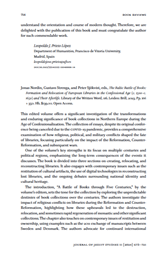
Jonas Nordin, Gustavs Strenga, and Peter Sjökvist (eds.), The Baltic Battle of Books: Formation and Relocation of European Libraries in the Confessional Age (c. 1500–c. 1650) and Their Afterlife (Brill, 2023) in Journal of Jesuit Studies, 11:4 (2024), pp. 714-16.
Abstract:
The Baltic Battle of Books investigates the shifting fate of book collections in Northern Europe during the Age of Confessionalization. The volume explores how religious, political, and military conflicts transformed libraries, focusing on the impact of the Reformation, the Counter-Reformation, and various regional wars. Through its interdisciplinary contributions, the book examines the creation, displacement, and reconstruction of monastic and Jesuit collections, while also engaging with contemporary debates about cultural restitution and digital efforts to recover lost heritage. By shedding light on the evolving roles of these libraries and the communities that shaped them, this work offers a nuanced understanding of Northern Europe’s cultural history and intellectual legacy during a turbulent era.
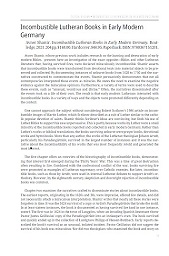
Avner Shamir, Incombustible Lutheran Books in Early Modern Germany (Routledge, 2021) in Theological Librarianship, 15, no. 1 (2022), pp. 19-21.
Abstract:
Avner Shamir’s book, Incombustible Lutheran Books in Early Modern Germany, explores the phenomenon of books surviving fires and being declared miraculously incombustible. Shamir investigates the narratives constructed around these events, demonstrating that not all contemporaries interpreted them as miracles. The book examines the material objects themselves, their use and portrayal after surviving fire, and the debates within Lutheranism regarding the existence of contemporary miracles. Through a wide range of primary sources, Shamir convincingly demonstrates the variety of opinions and the complex dynamics surrounding incombustible books in early modern Germany.